

Review: The Three Musketeers at Stanstead Bury Farm

Anyone eavesdropping outside the barn at Stanstead Bury Farm on Friday 30th May during The Three Musketeers – a latecomer, perhaps, or one of the ducks or geese – could be forgiven for thinking the show had a cast of twenty or so, with all manner of accents and the odd Frenchman thrown in for good measure. In reality, there were only four members of the theatre company This Is My Theatre gracing the stage that evening (three actors, supported by Lily Smith – listed as the ‘musician’ in the programme, but deftly contributing so much more than that). I, for one, still can’t quite believe there were so few of them. This multitalented troupe take multitasking to a whole new level: swapping hats, roles and guises slickly and with a knowing wink, they ensure there is never a dull moment in Alexandre Dumas’ epic tale of skulduggery and camaraderie.
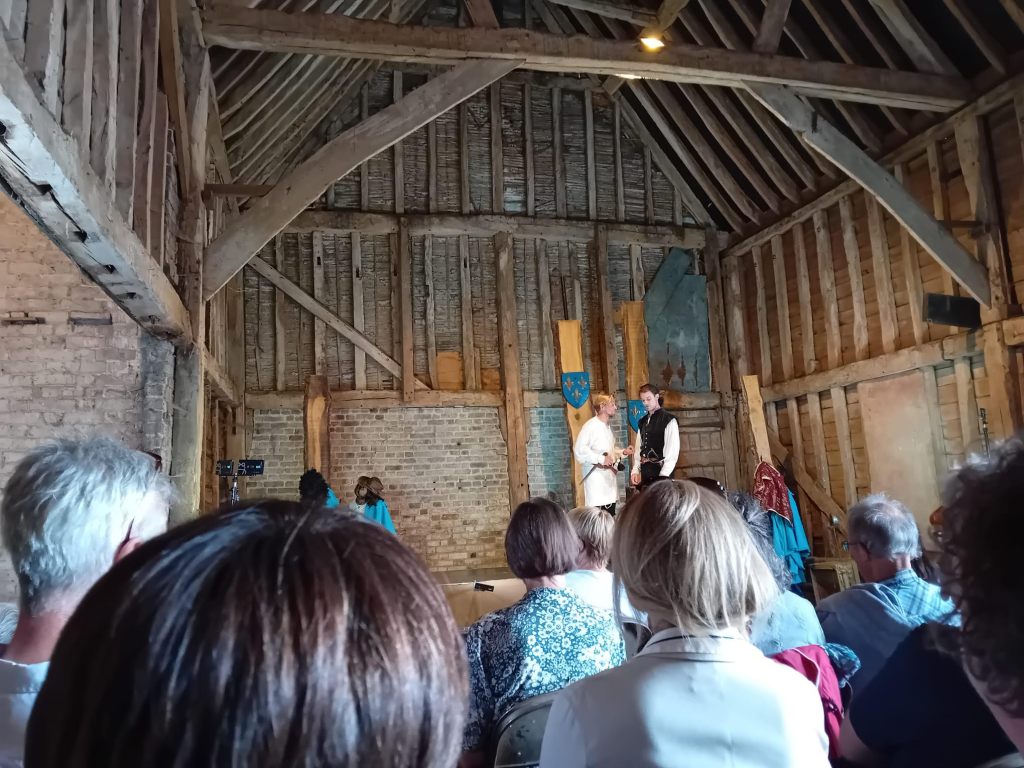
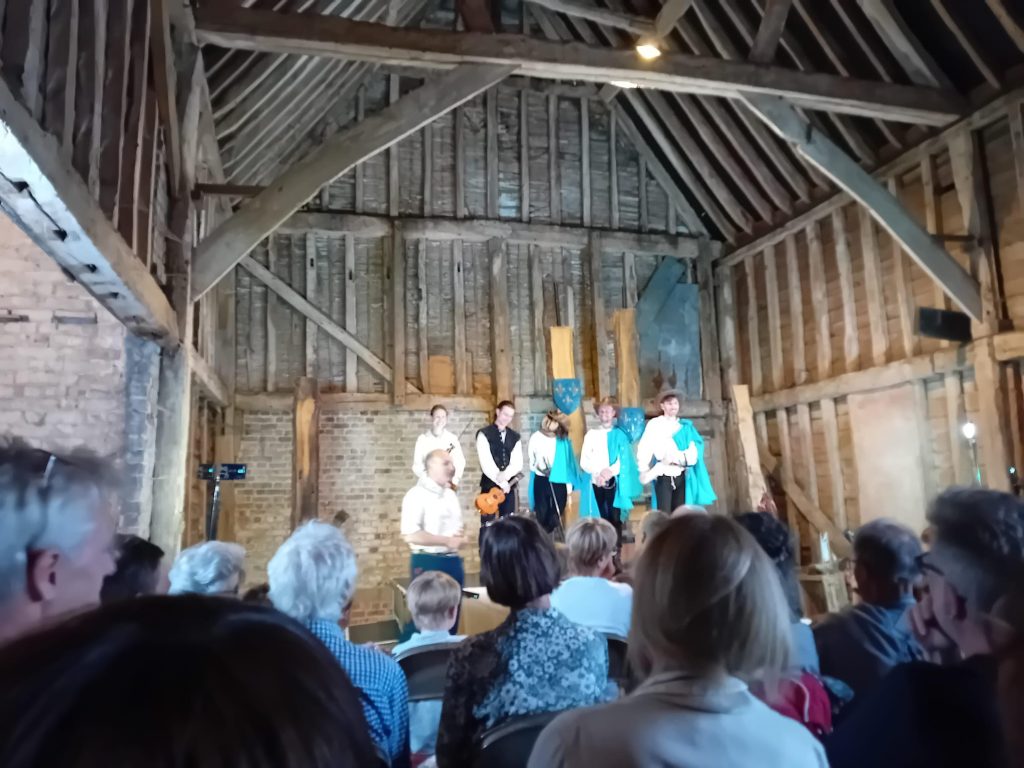
If some productions are underdone, this one is cooked to a ‘T’. A key ingredient is the expertly choreographed sword-fighting, which begins in the very first scene. We see the bold but naïve Gascon, d’Artagnan (Elliot Hay) receiving lessons in swordsmanship from his father (Duncan Woodruff), before setting off to make a name for himself in Paris. While en route, he is defeated in a genuine swordfight, and robbed, by the dastardly Rochefort (who bears a striking resemblance to his father). To make matters worse, our blundering hero manages to put three musketeers’ noses out of joint (one of them bears a striking resemblance…you get the idea). The duelling that ensues lands them in trouble with Cardinal Richelieu’s guards, leading to a mêlée between all sides that is a marvel to behold. In this whirlwind of cyan cloakology, it is hard to say which moves more quickly: the characters’ headgear as it is whipped from tête to tête, or their swishing blades. How the cast keep track of who’s who at any given moment is a mystery – it’s a feather in their cap that they do so! The upshot is that d’Artagnan, who helps to fight the guards off, becomes firm friends with the musketeers and is taken under their wing.
One of the musketeers, Porthos, is somewhat different from the others (Athos and Aramis), insofar as he is played by a mannequin atop a tripod. He certainly doesn’t let this hold him back, though. A helping hand wields his sword for him whenever necessary, and his guttural exclamations in French add to the play’s Gallic flair. Another character with an air of mystery to her is Milady de Winter, Cardinal Richelieu’s chief spy: using a hooded robe to good effect, she never lets us catch sight of her face. Dumas’ plot is convoluted, but it is centred around the need to retrieve a diamond necklace from an English duke, so that the French queen can wear it at a forthcoming ball (a ball that is definitely the suggestible king’s idea, and is not in any way dreamt up by the scheming cardinal). The queen will thus avoid embarrassment (the diamonds had been a gift from the king, but have somehow ended up with her secret lover, the duke of Buckingham). The musketeers bravely agree to undertake the journey to London: “En protégeant la reine, nous protégeons le roi!” (“By protecting the queen, we’re protecting the king!”). They travel with a speed that makes any frequent rail passengers in the audience turn green with envy, calling out the stops along the way: “Calais!” “Ashford!” “London!”
Alas, many of the characters in Dumas’ tale lack the loyalty and good character shown by the musketeers and will stop at nothing to foil their plans. The chief villain of the piece is Cardinal Richelieu, and special praise goes to Leon Topley for the stunning set-piece in which he plays both the Cardinal and the weaselly Bonacieux, dashing back and forth from one man’s floppy hat to the other’s red zucchetto. It is a real tour de force, and he repeats the trick later in the play…chapeau! The machinations of the various villains ultimately come to nothing, though, and d’Artagnan is rewarded for his heroics by being made a lieutenant in the King’s Musketeers.
This dazzling, rip-roaring show is a spectacular success. This Is My Theatre was founded with the aim of bringing great theatre to rural areas, and this production certainly fulfils that brief.
The theatre company will be back in Stanstead Abbotts later in the year, performing Pride and Prejudice – don’t miss it!
Huw Davies
for The Three Villages Magazine
 The Three Villages
What a superb review, Huw!!!
LikeLike