
Tag Archives: St Margrets

Why the Neighbourhood plan is so vital to our Village

Written by Julia Davies Chair, Stanstead Abbotts, St Margarets and the Folly Neighbourhood Plan Steering Group


After several years’ work of thoroughly exploring the settlement area, researching and discussing
the options for the future of the village, we plan to go ahead with the necessary regulation 14
consultation this Autumn.

This consultation will be open to any resident of Stanstead Abbotts Parish or St Margarets Parish or The Folly, who will all receive a summary of the plan through their door.


The entire plan will be online and available for people to read and we will be hoping to have online
feedback or alternatively written feedback through the post.

Any comments have to be considered by the Steering Group and if it is appropriate at the end of the consultation changes will be made.


There will be an open day when people can view paper copies of the Neighbourhood Plan and
supporting documents and ask how to complete their consultation response.


The plan will contain policies on green spaces and the natural environment; on the community and
leisure; on heritage and protection for the many much-loved historical features in the community;
there will be policies to encourage employment and others on transport addressing the needs of
residents who have a variety of reasons to travel.


We anticipate that most of the interest will be in the design features ensuring a sustainable
approach to developments and in the sites we allocate to deliver at least 94 homes which we were
tasked with finding at the outset by East Herts Council.

We had to map out which sites were in flood zones which ruled them out or green belt which we were very reluctant to intrude on. One of the powers that Neighbourhood Plan groups have is that they may release green belt land if it is set out in a strategic policy e.g. in the District Plan and there is evidence that it may be justified. We will be proposing the release of some of the land at Netherfield Lane –part of that site is brownfield land
which is the type of site that we consider to be ideal.


After the Regulation 14 consultation has closed, the responses taken into account, and amendments
made, it will be submitted to East Herts Council along with the Consultation Statement and statutory
maps etc.
East Herts Council will publish the documents online for a further consultation – Regulation 16.

ThePlan and the consultation comments will then be inspected by an independent Examiner and further
changes are likely to be made. If it is considered to meet the Basic Conditions, a referendum will
follow. All those people living in the Neighbourhood Plan Area will then have a chance to vote yes or
no, ie in favour or not in favour.

If more than 50% of the votes cast are in favour then the plan will be adopted by East Herts Council.

If the plan is adopted then no housing development outside the village boundary, other than that
selected in the plan will be granted planning permission by East Herts Council until 2033.

This is why the Neighbourhood Plan is so vital to the future of our village.

Wombles of Ware

Written by Maria Sell

Arguably the impact of the pandemic has changed resident’s view of their local towns and villages.

With many working from home, more time has also been spent exploring the surrounding areas while not being able to venture further afield.

For many this ignited a desire to look after, or in this case, help clean up their local communities.

Wombles of Ware Abouts is trying to do exactly this.  

When Andy Murphy and his wife Claudia Kohler started working from home following the first lockdown in March 2020 due to the Covid-19 pandemic they, like so many, spent more time taking walks through the neighbourhood and surrounding area.

Noticing the amounts of rubbish they thought: “It’s disgusting, why is no one doing anything about it?”

So once they became aware of the issue, they started litter picking by themselves.

Murphey said: “Over a couple of months, we must have picked 50 sacks of rubbish.

“Just in the streets and open spaces around here. And with all the greenery that had died back at that time of year, there was just stuff that had been in the bushes for years.” 

So they decided they needed to get more people involved and, over a few glasses of wine, the idea of Wombles of Ware Abouts was born.

In March this year they set up a Facebook page and group with the same name.

The idea was for everyone to adopt their own street, with Murphy keeping a map updated on the Facebook group that shows which streets have been adopted and which areas need more support, which, he adds, has been “effective and helpful for managing the group”. 

While the initial take-up was slow, once word of the Womble of Ware Abouts group got out via various local communities and environmental groups everything changed. 

“All of a sudden the numbers of people that were applying to join just sort of mushroomed. We went from 30 people in the first three days to 200 by the end of the week and we’ve now got 1,500 members.” 

There are now three more “Wombling” groups for different regions in Hertfordshire, including Hoddeston and Broxbourne, Hertford, and one for the local waterways, set up by a narrowboater that Murphy got talking to on the Facebook group.

“So basically it stretches from the M25 right up to Royston and almost all the way to Cambridgeshire.”

Not only has it helped clean up the streets and surrounding countryside, it’s also provided many people with a much needed sense of community, particularly during the difficult and stressful periods of lockdown. 

Murphy added: “People have said to us, it’s really helped their mental health because they’ve been able to go out and do something positive.”

Once more Covid restrictions have been lifted, he anticipates that more organised meet ups could happen. 

But the mental wellbeing aspect isn’t the only benefit Murphy sees, he also regards the educational benefit as an important aspect. 

According to Murphy 80% of the Wombles of Ware Abouts members are women, many with children of primary school age who tend to take them along.

”All those kids will get a taste for litter picking and when they grow up to being teenagers and adults they won’t be the ones littering the streets with their chip paper, or their McDonald’s wrappers, or facemasks.” 

Moreover, a couple of the local councils and organisations have also supported the initiative, such as Hertford Town Council which “dusted off an old litter picking scheme”. 

Murphy explains, “they’re prepared to give litter picking sets to people who join them. So if someone from Hertford joined the Wombles we can say go and talk to the council to say you’ve adopted a street with them and they’ll give you all the gear.” 

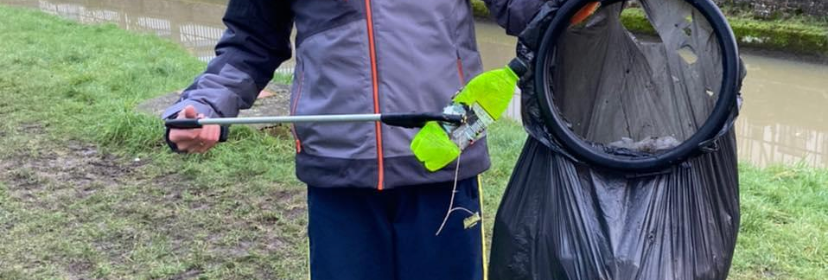
While a small organisation called Ware in Bloom, which looks after the planters on Ware High Street in summer, donated some money with which the Wombles of Ware Abouts bought litter picking sets that include a picker, some gloves and bin bags as well as a high vis jacket.

These will be made available to community groups such as primary and secondary schools, youth clubs, and scouts among others, and they can be picked up from a central point.  

So how can you get involved?

The easiest way is to join their Facebook Group the Wombles of Ware Abouts so you can adopt a street of your choice, or just help out while out and about on your daily walk. Every bit of litter picking helps towards the goal of a litter free neighbourhood.